Industrial Soot and Carbon Poultice Extraction
Newark borders major industrial zones and international aviation infrastructure. Heavy highway traffic produces dense diesel exhaust. Aircraft engines release unburnt hydrocarbon soot. The airborne carbon settles across local burial grounds like Mount Pleasant and Holy Sepulchre. Rainwater mixes with the atmospheric sulfur. The mixture forms a hard black crust on white marble monuments. The pollution bonds to the microscopic stone matrix. A standard water hose fails against this chemical layer. Wire brushes scratch the soft historic stone. Property owners require professional intervention. We perform headstone cleaning Newark. Field crews apply specialized chemical poultices. The thick paste covers the black stains. The chemical absorbs the deep sulfur deposits. The paste dries over several days. Technicians peel the dry material away. The black crust detaches from the stone. The original marble color returns. Low-pressure hoses flush the residue. The chemical extraction prevents irreversible surface damage.
Acid Rain Degradation and Marble Consolidation
Decades of factory emissions create acidic rain across Essex County. The acid rain dissolves the natural calcium binder in antique marble monuments. The smooth stone surface degrades into loose sand. The carved inscriptions vanish under the chemical stress. High-pressure water destroys the fragile material. Field crews execute delicate tombstone repair and restoration. Soft bristle brushes clear surface dirt. Technicians apply liquid stone consolidants. The low-viscosity fluid penetrates the porous marble matrix. The chemical deposits new silica binders inside the rock. The internal structure hardens. The chemical halts the active decay. We preserve the remaining structural mass. The preservation maintains the historic cemetery aesthetics. We manage faded inscriptions via headstone lettering restoration.
Heavy Red Clay and Foundation Elevation
Newark ground consists of dense red clay. The heavy soil traps surface water. The wet clay freezes during severe winter temperature drops. The ice expands upward. The frost heave tilts massive granite monuments. Unreinforced concrete foundations snap under the hydrostatic pressure. Flat markers sink into the resulting mud. We manage cemetery monument foundation lifting. Mechanical gantries extract the leaning stones. Field crews excavate the wet clay below the local frost line. Technicians install an angular crushed gravel foundation. The heavy rock pad supports the monument weight. The gravel forces immediate water drainage. The dry ground resists future frost heave. We reset the granite base flush and level. We eliminate the physical safety hazard. We secure the footprint.
Bronze Oxidation and Granite Stain Extraction
Industrial pollution attacks bare bronze plaques. The ambient moisture oxidizes the metal. A chalky green crust covers the raised lettering. Rain washes the green copper runoff onto the underlying granite base. The acidic runoff stains the porous stone. We execute bronze memorial refinishing. Chemical strippers dissolve the green corrosion. Heavy abrasive blocks cut the raised letters down to the bare alloy. Technicians spray a dark background paint. Specialized torches heat the plaque. Technicians melt solid wax into the open metal pores. The thick wax barrier blocks ambient moisture. Field crews apply chemical neutralizers to the stained granite. The liquid extracts the copper runoff. The rock returns to a uniform color.
Urban Vines and Structural Masonry Repair
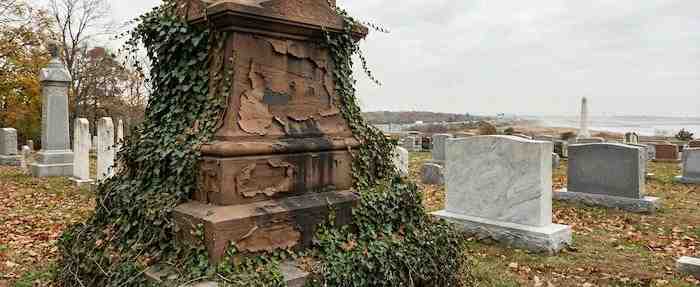
Historic walled cemeteries face aggressive ivy growth. The invasive vines drive micro-rootlets deep into masonry joints. The plant expansion pushes the stone blocks apart. Tall obelisks shift off center. Yanking active vines rips the historic mortar out. Technicians sever the main stems at the soil line. The isolated plant starves. The rootlets turn brittle. The dead vines detach from the rock face. Field crews clear the organic debris. We excavate the underground root ball. We perform detailed cemetery plot maintenance. Technicians repoint the damaged mortar seams. We inject structural stone epoxy into the open cracks. The resin locks the blocks together.
Mower Damage and Granite Beveling
Crowded urban plots leave narrow margins for commercial landscaping equipment. Heavy mower decks strike the granite bases. The steel blades chip the polished corners. The sharp edges become susceptible to further flaking. We correct the mechanical damage. Technicians run industrial diamond pads over the broken edges. The abrasive pads grind the sharp corners flat. We smooth the damaged granite. The structural beveling prevents progressive crumbling. We establish a clean dirt border around the base. The physical gap keeps landscapers away from the monument.
Logistics and Service Verification
Newark logistics demand precise operational planning. Poultice applications require multiple cemetery visits. Rebuilding foundations requires heavy gravel transport. Narrow historic cemetery roads complicate equipment access. Our mobile units carry dedicated water supplies. We handle all cemetery compliance paperwork. Clients receive a flat rate upfront. You track the project progress remotely. Field crews upload the final timestamped verification photo via our mobile and web app. The digital platform stores the service records.
- Carbon Extraction: Chemical poultices peel industrial soot out of marble pores.
- Marble Consolidation: Silica binders harden acid-damaged antique monuments.
- Clay Soil Leveling: Crushed rock foundations stabilize stones in wet red clay.
- Vine Eradication: Structural epoxy replaces mortar broken by invasive ivy roots.